
The operating layer
The operating layer for AI-powered customer operations.
Roux gives enterprises the system to define, run and control customer operations executed by AI — across channels, systems and teams.
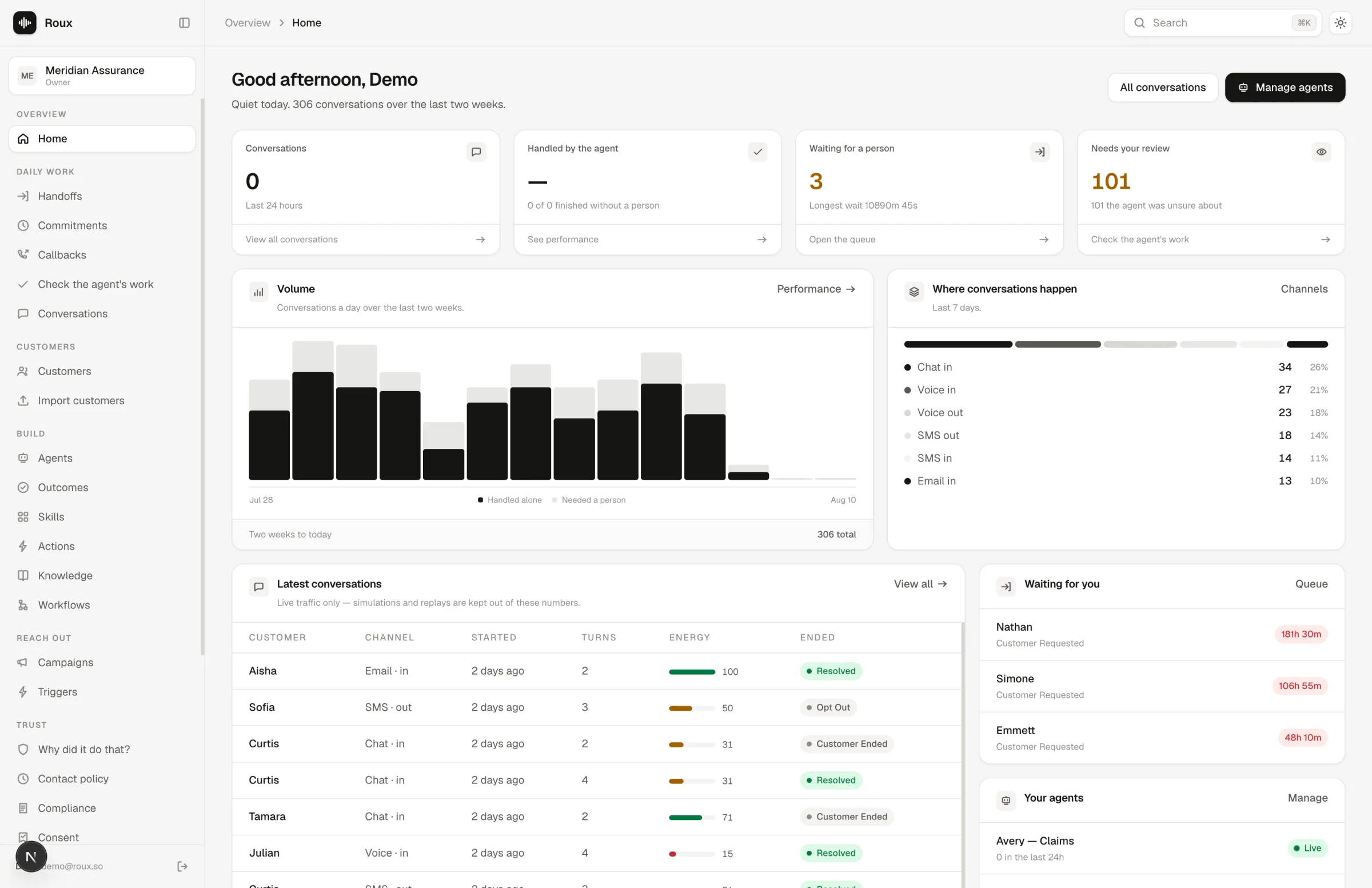
The product
One place to define, deploy and supervise every AI customer operation.
Design the workflow, connect the systems, define the guardrails, deploy across channels and monitor the outcome from one operating layer.
The problem
Customer operations were never just conversations.
Behind every customer interaction sits a web of systems, decisions, policies, handoffs and actions. AI can talk. The harder problem is letting it reliably operate the business behind the conversation.
behind one interaction
six layers
01
Customer
02
Conversation
03
Decisions
04
Systems
05
Actions
06
Outcome
AI can talk — the operation is everything after the conversation
Define → Execute → Control → Learn
How Roux works.
One operating cycle: the work is defined as software, executed by AI inside boundaries, supervised by people and improved from what actually happened.
- 01
Define
Turn customer operations into software: the steps, systems, decisions, boundaries and outcomes.
- 02
Execute
Run the operation across voice, chat and email with AI that can understand, decide and act.
- 03
Control
Set what AI may do, what needs approval, when a person steps in and how decisions can be understood.
- 04
Learn
Measure the outcome, find where the operation struggled and improve how it runs next time.
An operation, end to end
AI can talk. The operation is everything around and after it.
A refund that needs approval: Roux does not just reply. It orchestrates the work across AI, your systems and the person who can authorise it.
- 01
The customer contacts the company on the channel they already use.
- 02
Roux carries the previous interactions and the open case with it.
- 03
It understands the operation and the action the case actually requires.
- 04
It recognises the action exceeds its authority and needs approval.
- 05
It escalates to the right person, with the case attached.
- 06
The person picks it up in context instead of starting from zero.
- 07
The operation is completed, recorded and measured.
The unit of value is completed work, not a good reply.

Customer
This is the third time I'm calling about this refund. Every time I have to explain it all again.
Roux
You won't have to explain anything. I can see both earlier calls and the refund case.
Roux
This one needs approval authority, so I'm handing it to Marta on billing, with everything attached.
Marta
I have your whole case in front of me, including the last two calls. I can approve this now.
Execution
Across every channel, into every system.
Roux runs customer operations across voice, chat and email, using the business systems that hold the truth — and completing real work, not just answers.
operating layer
runtime
Channels
roux
One operating layer
Multiple channels. The same business logic behind them.
Business systems
Control & improvement
Autonomy, with boundaries.
Decide what AI is allowed to do, which actions require approval and when a person steps in. Then improve the operation from what each interaction reveals.
operation / order-issue.resolve
run
execution lane
- 01Policy: scope
Understand
Intent, entitlement and history read from the channel the customer chose.
- 02Permission: read
Retrieve context
Order, account and contract state pulled from the systems of record.
- 03Policy: limits
Apply rules
The written operation decides what is allowed, refused or escalated.
judgment requiredA named person decides, with the full context of the run. - 04Approval: required
Act
Refund, rebooking, dispatch or update executed in the business system.
- 05Record: written
Confirm outcome
The customer is told what happened, and the operation is closed as done.
record
every decision
why the operation chose this path
every action
which system was called, and with what
every handoff
who stepped in, when, and what they changed
Policies
Permissions
Approvals
Human intervention
Auditability
Compliance
Improvement loop
Every interaction becomes operational feedback: what worked, where the system struggled and which part of the operation should change next.
improvement loop
continuous
- 01
Interaction
A real customer runs through the operation, on the channel they chose.
- 02
Outcome
What actually happened is recorded — resolved, refused, escalated.
- 03
Evaluation
Runs are scored against the rules the business wrote, not vibes.
- 04
Insight
Patterns surface: the step that stalls, the case nobody defined.
- 05
Improvement
The operation is edited — a rule, a limit, a handoff, a message.
- 06
New version
Published with a version, and every later run is measured against it.
resolution
did the operation finish the job
escalation
when judgment was needed
effort
steps, time and handoffs per run
new version → next interaction
Solutions
Organised by business function
Every deployment starts from a customer operation your team already owns.




Deployments
Shaped around how your business actually works.
Enterprise operations are rarely plug-and-play. Roux works alongside your team to map the workflow, integrate the systems behind it, define the boundaries and move it into production.
= AI-native customer operation

Start with one operation.
Start with one high-value operation, deploy it safely, measure the outcome and expand from there.
Discuss a pilot →- 01
Define
- 02
Integrate
- 03
Test
- 04
Go live
- 05
Measure
- 06
Expand
Trust
Built for customer-facing operations.
Control, auditability and security belong inside the runtime — not in a slide added after the product is built.
01
Access control
02
Auditability
03
Data protection
04
AI governance
05
Human oversight

Which customer operation
should we start with?
Bring us one workflow. We’ll show you how Roux could run it.